
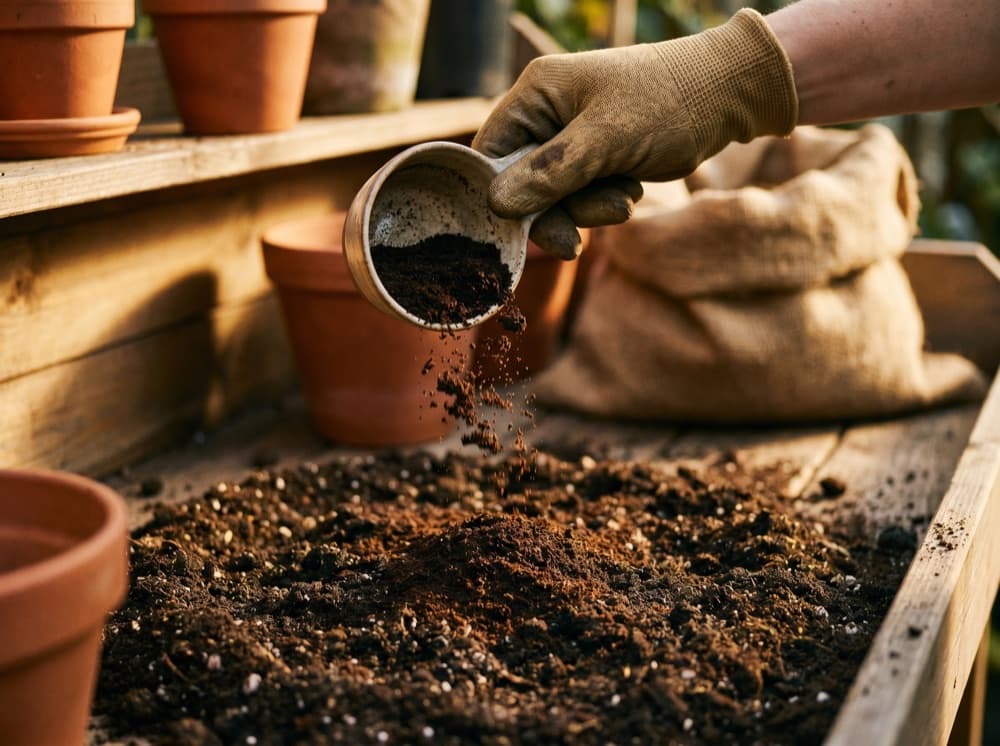
Every day, the cold-brew and instant coffee industry produces an enormous volume of spent coffee grounds, and for most of the world it is a waste stream. For us it is a raw material. The question worth asking is a simple one: what do those grounds actually do once they are in the ground?
The numbers behind the grounds
On paper, spent coffee grounds carry a lot of what a growing medium needs. Research from Texas A&M's Center for Coffee Research and Education puts them at roughly 2.3 percent nitrogen with a carbon-to-nitrogen ratio near 23:1, a slightly acidic pH around 5.6, and a useful range of macro and micronutrients including sulfur, magnesium, zinc, iron, and copper. The particles are also highly porous, which is a clue to how they behave once they are wet.
Why they earn a place in growing media
That porosity is the heart of it. Worked into a blend, spent coffee grounds hold water and nutrients well, hold onto applied nitrogen longer than many synthetic inputs, and open up the root zone so air and roots can move. The Texas A&M work even found turf roots growing straight into and through the grounds. They are not just filler in the mix. They are part of the structure plants grow into.
There is nuance, too. The benefits show up when the grounds are blended into a medium at a sensible rate, not piled on top or overdosed. That is exactly the job of a finished compost: take the raw material and turn it into something consistent and ready to grow in.
The short version
Spent coffee grounds are a renewable, nutrient-rich input that improves water holding, nutrient retention, and structure when they are composted and blended properly. It is why cold brew coffee compost is the foundation of every Mayer blend.
For the turf-specific research, see our summary of the Texas A&M turfgrass study.